174 views

The Role of ERP Selection Advisers | Expert Guidance for Smarter ERP Decisions

Selecting the right Enterprise Resource Planning (ERP) system is one of the most critical decisions a business can make. With numerous vendors and hundreds of features to evaluate, the process can quickly become overwhelming. This is where ERP selection advisers make a real difference—helping organizations navigate complexity, reduce risk, and maximize the return on their ERP investment.

What Do ERP Selection Advisers Do? 

ERP selection advisers are specialists who align your business objectives with the right technological solutions. These experts bring deep knowledge of both business processes and the rapidly evolving ERP landscape, ensuring your chosen system fits current requirements and positions you for future growth. Advisers help by: 

  • Assessing your organization’s unique needs—factoring in industry standards, scalability goals, and budget limitations. 
  • Leading evaluations of potential vendors, creating clear and unbiased selection criteria to compare features, usability, and support models. 
  • Guiding technical assessments and demonstration sessions so you see the right capabilities, not just flashy sales pitches. 

The Benefits of Hiring an ERP Adviser 

Bringing an adviser into your ERP selection process offers significant advantages: 

  • Reduced implementation risk: Advisers anticipate common pitfalls, such as insufficient requirements gathering or overlooked integration needs, helping your team avoid costly missteps and project overruns. 
  • Accelerated project timelines: With proven methodologies and prior experience, advisers streamline vendor evaluations, negotiation stages, and implementation planning, delivering systems faster and with fewer setbacks. 
  • Optimized ROI: Advisers ensure you invest only in features and modules your business actually needs, avoiding unnecessary expenditures and maximizing returns. 

Studies show that companies partnering with advisers are more likely to deploy ERP projects on time and within budget than those who go it alone. 

The Risks of Going Solo 

Without expert guidance, organizations face several hurdles: 

  • Misalignment with business needs: Failing to map requirements to actual business processes can result in selecting an ERP that’s a poor fit, leading to expensive modifications and diminished user adoption. 
  • Higher costs and delays: Attempting ERP selection without specialized expertise risks project scope creep, hidden costs from missed requirements, and ongoing delays due to unforeseen technical or integration challenges. 

In some reported cases, up to 70% of ERP projects have failed to achieve their intended objectives, often due to inadequate planning and lack of professional advice during the selection process. 

In summary: ERP selection advisers are more than just technical experts; they are strategic partners who help companies match technology with business ambition, reduce risk, and extract full value from a major investment. For any organization embarking on this journey, having the right adviser can make the difference between a costly misstep and a future-ready transformation. 

Let’s Solve Your ERP Challenges Together!

We’d love to hear from you! Tell us what ERP or business challenges you’re currently facing — and we’ll get back to you with tailored insights, solutions, or resources.

591 views

ERP with AI: The Future of Enterprise Resource Planning

The integration of Artificial Intelligence (AI) with Enterprise Resource Planning (ERP) systems is transforming how organizations manage their resources, make decisions, and gain competitive advantages. This powerful combination is not just a technological upgrade-it’s a fundamental shift in how businesses operate and strategize for the future. 

Current Applications of AI in ERP 

The marriage of AI and ERP has already yielded impressive results across various business functions. Let’s explore the key technologies driving this transformation: 

Machine Learning for Predictive Analytics 

Machine Learning algorithms are revolutionizing ERP systems by analyzing historical data to identify patterns and trends that would be impossible for humans to detect manually. These AI-powered ERP solutions leverage advanced algorithms to anticipate future trends, identify potential risks, and recommend optimal courses of action. Whether predicting inventory needs or forecasting sales, ML-driven ERP systems provide businesses with the insights needed to make proactive rather than reactive decisions. 

Modern ERP systems utilize ML, data mining, and predictive analytics to process vast amounts of information, enabling businesses to make smarter decisions based on data-driven intelligence rather than guesswork. For manufacturers, this means more accurate demand forecasting, optimized production schedules, and improved resource allocation. 

Natural Language Processing for Streamlined Communication 

Natural Language Processing (NLP) capabilities are enhancing how users interact with ERP systems. AI-powered chatbots and virtual assistants enable employees to query company data, generate reports, and perform complex tasks using conversational language rather than learning specific system commands or navigation paths. 

This technology democratizes access to data across organizations, allowing non-technical staff to extract valuable insights without specialized training. When an inventory manager can simply ask, “What products are running low this month?” and receive an accurate response, the efficiency gains are substantial. 

Robotic Process Automation for Operational Efficiency 

Robotic Process Automation (RPA) is eliminating repetitive, manual tasks that have traditionally consumed valuable human resources. Modern autonomous ERP systems integrate RPA to create self-managing, self-optimizing, and self-healing systems that minimize human intervention in routine processes. 

Tasks such as data entry, invoice processing, and inventory management can now be automated, reducing human errors and increasing efficiency. This automation frees employees to focus on more strategic, value-added activities that require human creativity and problem-solving skills. In manufacturing environments, this translates to increased throughput and enables innovation and continuous improvement processes. 

Image Processing for Advanced Quality Control 

One of the most impressive applications of AI in ERP is in quality control through advanced image processing and computer vision. In manufacturing settings, AI-powered visual inspection systems can detect product defects, ensure proper packaging, and verify product specifications with unprecedented accuracy and speed. 

These systems follow a systematic process that includes image capture, processing, comparison against quality standards, and automated decision-making. For example, computer vision can inspect labels on bottles or containers to ensure they are correctly applied, legible, and match the product inside. This technology has made quality control more reliable while significantly reducing the cost of inspections. 

In production line monitoring, advanced statistical quality control techniques using image intelligence help analyze complex image data streams, detecting shifts in quality and identifying faulty regions with remarkable precision. 

The Next Wave of AI in Enterprise Resource Planning 

As impressive as current AI applications in ERP are, the next generation promises even greater transformations: 

Autonomous Decision-Making Systems 

The concept of autonomous ERP represents a quantum leap from traditional systems. These advanced platforms minimize human intervention not just in routine tasks but in complex decision-making processes as well. Autonomous ERP systems continuously monitor and analyze business processes, identifying inefficiencies and implementing improvements without requiring human intervention. 

This self-optimizing capability leads to increased productivity and cost savings by automatically adjusting processes based on changing conditions. For example, an autonomous ERP might automatically adjust production schedules when it detects supply chain disruptions or changes in customer demand patterns. 

AI-Powered Scenario Planning and Forecasting 

The next generation of ERP systems will excel at scenario planning and forecasting, giving businesses unprecedented ability to prepare for multiple future scenarios. AI-based predictive analytics are already transforming demand forecasting in ERP systems by synthesizing and analyzing vast datasets to identify patterns invisible to human analysts. 

Future systems will take this further by simultaneously modeling multiple business scenarios and recommending optimal strategies for each. Rather than simply predicting what might happen, these systems will advise on what should be done in response to changing conditions. 

Deep Integration with IoT and Real-Time Analytics 

Real-time data processing represents another frontier for AI-powered ERP. Modern systems excel at consistently evaluating and interpreting extensive operational data, enabling manufacturers to make informed decisions without delay. 

Instead of relying on end-of-day reports, AI-driven ERPs provide live dashboards that monitor production metrics, inventory levels, and quality control indicators. Decision-makers can immediately adjust production schedules or reallocate resources based on current conditions, driving greater efficiency and agility in dynamic markets. 

Why Businesses Should Prepare for AI in Enterprise Resource Planning

The transition to AI-powered ERP isn’t just about staying current with technology-it’s about business survival and growth in an increasingly competitive landscape. 


Enhanced Productivity and Innovation 

AI-driven automation increases productivity by handling routine tasks with greater speed and accuracy than human workers. This automation enables human resources to focus on more strategic, high-value activities, fostering innovation and continuous improvement in business processes. 

When employees are freed from data entry, report generation, and other routine administrative tasks, they can devote more energy to creative problem-solving, strategic planning, and customer relationship management-activities where human intelligence still far surpasses artificial intelligence. 

Competitive Advantage in a Rapidly Evolving Market 

Companies that implement AI-driven ERP solutions gain a significant competitive edge. These early adopters can deliver results faster and more accurately while responding to changing market requirements much quicker than competitors using traditional systems. 

In today’s fast-paced business environment, the ability to quickly adapt to market changes, customer preferences, and supply chain disruptions is often the difference between market leaders and followers. AI-powered ERP systems provide the agility needed to thrive in uncertain conditions. 

Conclusion 

The integration of AI with ERP represents a paradigm shift in how businesses manage their operations and make decisions. From machine learning and natural language processing to robotic process automation and image intelligence, these technologies are already delivering substantial benefits to early adopters. 

As we look toward the future of autonomous decision-making, advanced forecasting, and real-time analytics integration, it’s clear that AI-powered ERP will be a cornerstone of successful businesses. Organizations that embrace these technologies now will be better positioned to enhance productivity, foster innovation, and maintain competitive advantage in increasingly challenging markets. 

The question is no longer whether businesses should adopt AI-powered ERP, but how quickly can they implement these systems to avoid being left behind in the next wave of digital transformation.  

Let’s Solve Your ERP Challenges Together!

We’d love to hear from you! Tell us what ERP or business challenges you’re currently facing — and we’ll get back to you with tailored insights, solutions, or resources.

TAGS:
1,479 views

How IFS Cloud Revolutionizes Manufacturing Processes in 2025 

The manufacturing industry in 2025 faces unprecedented challenges, from fluctuating customer demands and rising raw material costs to supply chain disruptions and labor shortages. In this dynamic landscape, IFS Cloudhas emerged as a transformative solution, enabling manufacturers to streamline operations, enhance efficiency, and maintain a competitive edge. Here’s how IFS Cloud is revolutionizing manufacturing processes this year. 


1. Service-Centric Approach Tailored for Manufacturers

Unlike traditional ERP systems, IFS Cloud adopts a service-centric model that aligns closely with manufacturers’ unique needs. Its modular architecture integrates various critical systems—such as ERP, Manufacturing Execution Systems (MES), Product Lifecycle Management (PLM), and Customer Relationship Management (CRM)—into a unified platform. This holistic integration ensures seamless workflows across the entire production lifecycle, from planning to shipment. 

For example, manufacturers using configure-to-order (CTO) or engineer-to-order (ETO) processes can leverage IFS Cloud’s tailored modules to manage complex customizations efficiently while reducing lead times. 


2. AI-Driven Insights for Operational Efficiency

IFS Cloud leverages artificial intelligence (AI) and machine learning to optimize manufacturing processes. AI-powered tools like predictive maintenance help foresee equipment failures, minimizing downtime and maintenance costs. Similarly, demand forecasting analyzes historical data and market trends to optimize inventory levels and meet customer demands with precision. 

A real-world application of this is seen in manufacturing plants where AI-driven scheduling tools identify bottlenecks on production lines and suggest adjustments in real time. This not only improves throughput but also enhances overall equipment effectiveness (OEE). 


3. Industry-Specific Modules for Unique Challenges

Manufacturers operate in diverse sectors—ranging from discrete and process manufacturing to mixed-mode production—and each has its own set of challenges. IFS Cloud addresses these complexities with industry-specific modules designed for modes like make-to-stock (MTS), make-to-order (MTO), and batch process manufacturing. 

For instance, pharmaceutical manufacturers can use formula-based modules to ensure compliance with stringent regulatory requirements while maintaining high product quality. Similarly, food manufacturers benefit from tools that manage recipes and batch tracking seamlessly. 


4. Seamless Integration with Existing Systems

One of IFS Cloud’s standout features is its ability to integrate seamlessly with existing systems and third-party solutions. Whether it’s connecting with shopfloor equipment for real-time data capture or integrating with external MES platforms, IFS Cloud ensures smooth interoperability without disrupting ongoing operations. 

This capability is particularly valuable for manufacturers transitioning from legacy systems to modern cloud-based solutions. By eliminating the need for costly hardware upgrades, IFS Cloud reduces IT overhead while enabling scalability. 


5. Enhanced Collaboration Across Departments

In today’s globalized manufacturing environment, effective collaboration is critical. IFS Cloud fosters enhanced teamwork by providing mobile accessibility and real-time data sharing across departments. Teams can access dashboards, share documents, and make decisions collaboratively from any location. 

For example, a plant manager can monitor production metrics remotely while coordinating with procurement teams to address potential supply chain disruptions proactively. This agility not only improves responsiveness but also boosts customer satisfaction through timely deliveries. 


Real-World Impact: Driving Efficiency and Growth 

Manufacturers adopting IFS Cloud report tangible benefits such as: 

  • Cost Savings: Predictive maintenance reduces downtime costs, while cloud hosting eliminates the need for expensive on-premises infrastructure. 
  • Enhanced Quality Control: Integrated quality management tools ensure consistent product standards while reducing waste. 

For instance, a leading automotive parts manufacturer using IFS Cloud reduced lead times by 20% while achieving a 15% increase in production efficiency through optimized resource allocation and predictive analytics. 


Summary 

IFS Cloud has redefined what’s possible in manufacturing by combining advanced technologies like AI, IoT integration, and industry-specific functionality into one powerful platform. Its ability to adapt to unique operational needs while enhancing collaboration and efficiency makes it an indispensable tool for manufacturers navigating the challenges of 2025. 

As the industry continues to evolve, embracing solutions like IFS Cloud will be critical for staying competitive in an increasingly digital world. 


Let’s Solve Your ERP Challenges Together!

We’d love to hear from you! Tell us what ERP or business challenges you’re currently facing — and we’ll get back to you with tailored insights, solutions, or resources.

TAGS:
648 views

Common Pitfalls in ERP Selection and How Consultants Help Avoid Them 

Deciding on the right Enterprise Resource Planning (ERP) system is a pivotal step for businesses aiming to streamline operations and improve efficiency. However, the process is fraught with challenges, and many organizations fall into common pitfalls that can derail their ERP projects.  

With up to 75% of ERP implementations failing in their first year due to poor selection processes, the stakes are high. This is where ERP consultants come in, offering expertise to navigate these challenges effectively. Below, we explore the most frequent mistakes businesses make during ERP selection and how consultants help avoid them. 


Common Pitfalls in ERP Selection 

1. Inadequate Needs Assessment Leading to Misalignment 

One of the most critical mistakes companies make is failing to thoroughly assess their organizational needs before diving into the ERP selection process. Without a clear understanding of existing workflows, pain points, and future goals, businesses often end up with systems that don’t align with their requirements. For example, a manufacturing company may choose an ERP system focused on retail features, leading to inefficiencies in production planning and inventory management. 

2. Overlooking Hidden Costs 

ERP systems often come with hidden costs that go beyond the initial purchase price. These include expenses for customizations, training, ongoing maintenance, and upgrades. Many organizations underestimate the total cost of ownership (TCO), leading to budget overruns. For instance, companies that focus solely on upfront savings may later discover that their chosen solution requires extensive customizations or third-party integrations. 

3. Lack of Industry-Specific Knowledge 

ERP systems are not one-size-fits-all solutions. Businesses often fail to account for industry-specific requirements when selecting an ERP platform. For example, a retail business might need advanced inventory tracking and omnichannel capabilities, while a healthcare organization may prioritize compliance features like HIPAA data security. Choosing a generic system without considering these nuances can result in costly inefficiencies. 

How Consultants Help Avoid These Pitfalls 

1. Conducting Thorough Requirement Analysis 

ERP consultants excel at identifying an organization’s unique needs through comprehensive requirement analyses. They work closely with stakeholders across departments to map out current workflows and pinpoint areas for improvement. For example, a consultant might uncover that delays in order processing are due to outdated inventory tracking systems and recommend an ERP solution with real-time inventory management capabilities. 

By aligning the ERP system with business objectives, consultants ensure that the selected platform supports both current operations and long-term growth. 

2. Providing Transparent Cost Breakdowns 

Consultants help businesses avoid financial surprises by offering detailed cost breakdowns that include all potential expenses—software licensing, implementation services, training, and ongoing support. They also use benchmarks from past projects to provide realistic estimates of TCO. For instance, if a vendor’s proposal omits critical costs like data migration or annual maintenance fees, a consultant can flag these omissions early in the process. 

This transparency helps organizations budget accurately and avoid overspending. 

3. Leveraging Industry Expertise for Better Alignment 

Experienced consultants bring deep industry knowledge to the table, ensuring that the chosen ERP system aligns with sector-specific requirements. For instance, in retail, consultants might recommend solutions with robust point-of-sale (POS) integration and customer analytics tools tailored to omnichannel strategies. In contrast, for manufacturing businesses, they might prioritize features like quality control tracking or advanced supply chain management. 

This expertise helps businesses select systems that are not only functional but also optimized for their specific industry challenges. 


Real-Life Examples of Consultant Impact 

  • A high-volume distribution company struggling with delayed order confirmations worked with consultants who identified gaps in sales order management processes. By selecting an ERP system tailored to address these gaps, they improved order win rates and achieved their goal of increasing top-line revenue by 10%. 
  • HP’s failure to implement a suitable ERP system led to $120 million in order pileups and $40 million in lost revenue within a single quarter. A skilled consultant could have mitigated this by ensuring proper needs assessment and vendor evaluation. 


Summary 

The risks of navigating ERP selection alone are too great for most organizations. From misaligned systems to hidden costs and poor customization choices, these pitfalls can lead to wasted resources and missed opportunities for growth. Engaging an experienced consultant ensures that your ERP selection process is thorough, strategic, and aligned with your business goals. 

With their ability to conduct detailed analyses, provide transparent cost insights, and leverage industry-specific expertise, consultants act as invaluable partners in what could otherwise be a daunting journey. By avoiding common pitfalls and making informed decisions, your business can unlock the full potential of its ERP investment—setting the stage for long-term success. 


Let’s Solve Your ERP Challenges Together!

We’d love to hear from you! Tell us what ERP or business challenges you’re currently facing — and we’ll get back to you with tailored insights, solutions, or resources.

TAGS:
432 views

5 Critical Reasons to Hire a Consultant Before Choosing Your ERP Solution

Selecting an Enterprise Resource Planning (ERP) system is one of the most critical decisions a business can make. The right ERP solution can streamline operations, enhance productivity, and support long-term growth. However, the process of choosing an ERP is fraught with complexities, from assessing organizational needs to evaluating vendors and managing risks. This is where an experienced ERP consultant becomes indispensable. Below are five key reasons why engaging a consultant before choosing your ERP solution can make all the difference. 

1. Expertise in Assessing Organizational Needs 

Understanding your business’s unique requirements is the foundation of selecting the right ERP solution. Many organizations struggle to align their operational needs with the features of available ERP systems, often leading to costly mismatches. A consultant conducts a thorough needs assessment, identifying inefficiencies, bottlenecks, and growth opportunities within your current processes. For example, a retail business planning to expand its e-commerce operations might require robust inventory management and customer analytics features in its ERP system. 

By aligning the ERP solution with your strategic goals, consultants ensure that you choose a system that not only meets current needs but also scales with future growth. 

2. Objective Vendor Evaluations and Unbiased Recommendations 

The ERP market is saturated with vendors offering diverse solutions, each claiming to be the “best fit.” Without proper expertise, businesses may fall prey to biased recommendations or marketing gimmicks. Independent consultants provide an unbiased perspective by evaluating vendors based on your specific requirements rather than vendor affiliations or incentives. 

For instance, consultants can create an evaluation matrix to compare vendors on factors like scalability, integration capabilities, and total cost of ownership. This objective approach helps businesses avoid costly mistakes, such as selecting a system that fails to integrate with existing tools or lacks critical functionality. 

3. Efficient Project Planning and Risk Management 

ERP implementation is inherently risky, with challenges ranging from budget overruns to operational disruptions. A consultant brings expertise in project planning and risk management, ensuring that potential pitfalls are identified and mitigated early in the process. 

For example, a UK-based energy company successfully implemented its ERP system by adopting a risk assessment framework guided by consultants. This systematic approach reduced risk exposure and ensured smooth implementation. Consultants also help allocate resources effectively, set realistic timelines, and establish clear milestones to keep the project on track. 

4. Customization Insights Tailored for Retail Businesses 

Retail businesses often require highly customized ERP solutions to handle unique challenges like seasonal demand fluctuations, supply chain complexities, and omnichannel operations. Consultants bring industry-specific insights to the table, helping tailor the ERP system to meet these specialized needs. 

For instance, they can recommend features such as real-time inventory tracking or integrated point-of-sale (POS) systems that are crucial for retail success. Without this expertise, businesses risk investing in generic solutions that fail to address their specific pain points. 

5. Ongoing Support During Implementation and Beyond 

The role of an ERP consultant doesn’t end once the system is selected. They provide ongoing support during implementation, ensuring user training, change management, and system integration are handled effectively. This support extends beyond go-live to address any post-implementation challenges. 

For example, consultants can facilitate user adoption by creating comprehensive training programs tailored to different departments within your organization. This ensures that employees are equipped to use the new system efficiently, maximizing ROI and minimizing disruptions. 

Summary 

Engaging a consultant during your ERP selection process is not just about avoiding mistakes—it’s about setting your business up for long-term success. From aligning the system with your strategic goals to ensuring smooth implementation and adoption, consultants bring invaluable expertise at every stage of the process. 

In today’s competitive landscape, businesses cannot afford to take chances with their ERP investments. By partnering with an experienced consultant, you gain not only peace of mind but also a powerful tool tailored to drive efficiency and growth for years to come. 

Let’s Solve Your ERP Challenges Together!

We’d love to hear from you! Tell us what ERP or business challenges you’re currently facing — and we’ll get back to you with tailored insights, solutions, or resources.

TAGS:
606 views

The Role of ERP in Transforming Retail Operations  

In today’s rapidly evolving retail landscape, staying competitive requires more than just offering the right products. It demands streamlined operations, data-driven decision-making, and exceptional customer experiences. Enterprise Resource Planning (ERP) systems have emerged as a game-changer for retailers, offering a centralized platform to manage various aspects of their business, from inventory and supply chain to customer relationships and financials.Let’s explore how ERP is transforming retail operations.  

Key Benefits of ERP for Retailers 

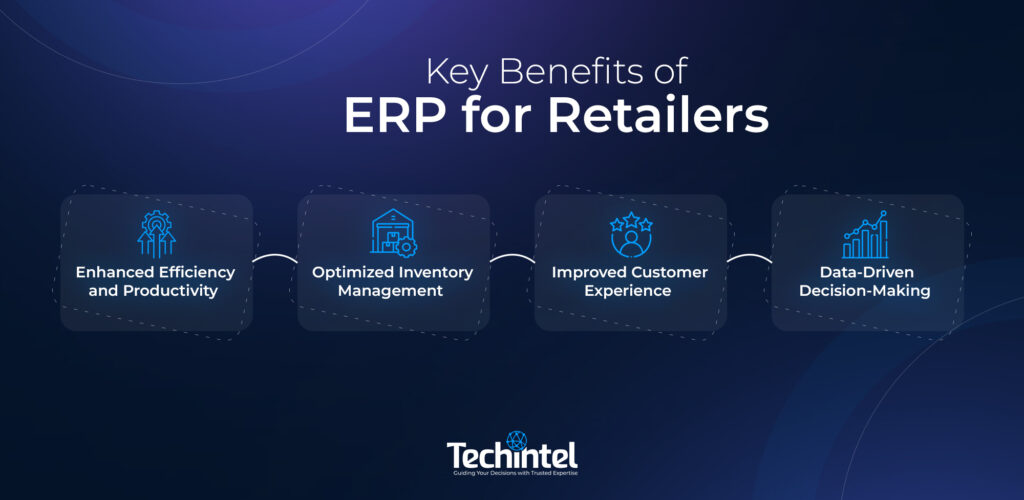
  • Enhanced Efficiency and Productivity: ERP systems automate processes, reduce manual data entry, and streamline workflows, leading to significant improvements in efficiency and productivity. By centralizing data and providing real-time visibility into operations, ERP enables retailers to optimize resource allocation, minimize errors, and improve decision-making. For instance, 66% of organizations report that ERP systems have improved their operational efficiency. 
  • Optimized Inventory Management: Accurate inventory tracking, demand forecasting, and supply chain optimization are critical for retailers. ERP systems provide real-time insights into inventory levels, allowing retailers to minimize stock outs, reduce excess inventory, and improve order fulfillment. Optimized inventory levels are the most common benefit realized for nearly 91% of companies using ERP. 
  • Improved Customer Experience: In today’s competitive market, customer experience is paramount. ERP systems enable retailers to personalize marketing campaigns, provide targeted sales promotions, and offer seamless omnichannel experiences. By integrating customer data from various touchpoints, ERP provides a 360-degree view of the customer, enabling retailers to enhance customer service, increase customer loyalty, and drive sales. 
  • Data-Driven Decision-Making: ERP systems consolidate data from across the organization, providing retailers with a unified data hub for business intelligence and analytics. With real-time access to sales information, inventory levels, and customer preferences, retailers can make more informed decisions about pricing, promotions, and product offerings. 
Key Benefits of ERP for Retailers

Case Studies of Successful ERP Implementation 

Several major companies have successfully implemented ERP systems to transform their retail operations: 

  • Amazon: Utilizes SAP ERP for operational efficiency and big data insights, enhancing agility and competitive advantage. 
  • Starbucks: Implemented Oracle ERP to automate back-office processes, achieving significant improvements in efficiency, productivity, and service quality. 
  • Zara: The fashion retailer Zara implemented an ERP system that allowed for a highly responsive supply chain. This system enables quick response to fashion trends and consumer demands, significantly reducing time to market. 
  • Nike: Fine-tuned its ERP system to better manage its global supply chain and inventory, resulting in improved order fulfillment, efficiency, and customer satisfaction. 

Future Trends in Retail ERP: Integration with AI and Machine Learning 

Looking ahead, the integration of Artificial Intelligence (AI) and Machine Learning (ML) is poised to further revolutionize retail ERP. AI and ML enable retailers to unlock the full potential of their data, provide predictive insights, and automate critical processes. 

  • Predictive Analytics: AI-powered ERP systems can analyze historical data to forecast demand more accurately, enabling retailers to optimize inventory management and prevent stockouts. 
  • Personalized Customer Experiences: By analyzing customer behavior, AI-driven ERP systems can help retailers tailor marketing campaigns, product recommendations, and pricing strategies to individual customers. 

Summary 

In conclusion, ERP systems are playing a pivotal role in transforming retail operations by enhancing efficiency, optimizing inventory management, improving customer experience, and enabling data-driven decision-making. As AI and machine learning become increasingly integrated into ERP solutions, retailers can expect even greater levels of automation, personalization, and predictive capabilities. By embracing ERP, retailers can position themselves for success in today’s dynamic and competitive market. 

Let’s Solve Your ERP Challenges Together!

We’d love to hear from you! Tell us what ERP or business challenges you’re currently facing — and we’ll get back to you with tailored insights, solutions, or resources.

TAGS:
578 views

3 Key Benefits of ERP for Small Business Reporting & Analytics

In today’s fast-paced business environment, small businesses must leverage data to stay competitive. Reporting and analytics are no longer luxuries—they’re necessities for informed decision-making, improved efficiency, and sustainable growth. Enterprise Resource Planning (ERP) systems offer small businesses powerful tools to streamline operations and gain actionable insights. Let’s explore three key benefits of using ERP for reporting and analytics. 

1. Streamlined Data Collection and Management 

One of the most significant challenges for small businesses is managing data from various sources, such as sales, inventory, customer interactions, and financial transactions. And ERP simplifies this by centralizing all data into a unified platform. This eliminates the need to rely on multiple software systems or manual data entry, which can lead to errors and inefficiencies. 

For example, a small retail business might struggle with stockouts or overstocking due to fragmented inventory data. By implementing an ERP, the business can integrate its sales and inventory data in real time, enabling better stock management. This not only reduces waste but also ensures that popular items are always available, boosting customer satisfaction. 

Additionally, the automation features in an ERP reduce the time spent on repetitive tasks like manual reporting, allowing employees to focus on strategic initiatives. 

2. Enhanced Decision-Making Through Real-Time Insights 

An ERP provides real-time analytics and reporting capabilities that empower small businesses to make informed decisions quickly. With access to up-to-date data visualizations and dashboards, business owners can identify trends, monitor key performance indicators (KPIs), and respond proactively to market changes. 

For instance, consider a neighborhood bakery that uses an ERP to analyze daily sales trends. By identifying which products sell best on specific days or during certain seasons, the bakery can adjust its production schedule accordingly. This kind of data-driven decision-making led one bakery to reduce waste by 30% while increasing sales by 20%—a clear testament to how real-time insights can drive profitability. 

Moreover, predictive analytics within an ERP can help small businesses forecast future trends, enabling them to prepare for demand fluctuations or optimize their marketing strategies. 

3. Cost-Effective Solutions Tailored for Small Businesses 

Small businesses often operate with limited budgets, making cost-effective solutions essential. An ERP offers modular features that allow businesses to pay only for what they need, making it an attractive option for companies with annual revenues under $30 million. 

Unlike larger corporations that may require extensive customization, small businesses can benefit from out-of-the-box solutions provided by an ERP. These solutions are designed to be scalable, ensuring that as the business grows, the system can adapt without requiring a complete overhaul. 

For example, a local restaurant might initially use an ERP’s financial management module to track expenses and revenue. As the business expands into catering services or additional locations, it can integrate other modules like supply chain management or project planning without incurring significant costs upfront. 

Summary 

By streamlining data collection, providing real-time insights, and offering cost-effective solutions tailored for small businesses, an ERP equips companies with the tools they need to thrive in competitive markets. Whether you’re managing inventory at a retail store or analyzing customer preferences at a restaurant, the ability to harness your data effectively can be transformative. 

Small businesses that invest in robust reporting and analytics tools like an ERP not only improve operational efficiency but also position themselves for long-term success. In an era where 51% of small businesses see big data as essential, adopting an ERP system like  AN is no longer optional—it’s a strategic imperative. 

Let’s Solve Your ERP Challenges Together!

We’d love to hear from you! Tell us what ERP or business challenges you’re currently facing — and we’ll get back to you with tailored insights, solutions, or resources.

TAGS:
586 views

4 Ways Retail Businesses Benefit from Hiring ERP Advisors Before Selection 

Retail businesses operate in a fast-paced, competitive environment where every decision can significantly impact efficiency and profitability. Implementing an Enterprise Resource Planning (ERP) system is one of the most transformative decisions a retailer can make. However, selecting the right ERP solution is fraught with challenges, from integrating complex retail processes to ensuring scalability and compliance. This is where hiring ERP advisors before making a selection becomes invaluable. Below, we explore four key ways retail businesses benefit from engaging ERP advisors early in the process. 

1. Tailored Solutions for Specific Retail Needs 

Retailers have unique requirements that differ significantly from other industries. From managing diverse product lines and omnichannel sales to handling seasonal demand fluctuations, the retail sector demands highly customized ERP solutions. ERP advisors bring expertise in mapping these specific needs to the right software features, ensuring that the chosen system aligns perfectly with the retailer’s operations. 

For instance, an advisor might recommend a cloud-based ERP for a retailer planning rapid expansion due to its scalability and flexibility. Without such tailored guidance, retailers risk investing in systems that either lack critical functionalities or are overly complex for their needs. 

2. Access to a Network of Reliable Vendors and Solutions 

The ERP market is vast, with countless vendors offering varying levels of quality and service. Navigating this landscape can be overwhelming for retailers unfamiliar with the nuances of ERP solutions. Advisors bring an established network of reliable vendors and deep insights into their offerings. 

For example, consulting firms like Pemeco Consulting specialize in pre-qualifying vendors based on a retailer’s specific needs, saving time and reducing risks associated with vendor selection. This ensures that retailers partner with vendors who have a proven track record in delivering successful retail ERP implementations. 

3. Enhanced Negotiation Strategies for Better Contract Terms 

ERP contracts often involve significant financial commitments and long-term agreements. Retailers without prior experience may overlook critical terms or fail to negotiate effectively, leading to unfavorable conditions or hidden costs down the line. 

ERP advisors leverage their experience to secure better pricing, flexible terms, and robust service level agreements. For instance, by working with consultants like Net at Work, businesses have achieved streamlined workflows and reduced operational inefficiencies through well-negotiated contracts. This expertise can translate into substantial cost savings and improved ROI for retailers. 

4. Guidance on Compliance and Regulatory Requirements 

Compliance is a critical concern for retailers handling sensitive customer data or operating across multiple regions with varying regulations. An ERP system must adhere to standards like GDPR or PCI DSS while maintaining robust data governance protocols. 

ERP advisors ensure that compliance requirements are integrated into the selection process. They help retailers choose systems that not only meet current regulatory standards but are also adaptable to future changes. This minimizes legal risks and enhances customer trust by safeguarding sensitive information. 

Real-Life Impact: A Success Story 

Consider Midway, a wholesale distributor transitioning from a legacy system to Acumatica with the help of Net at Work. By leveraging expert advice during vendor selection and implementation, Midway achieved a 25% increase in efficiency while improving cash flow management. This example underscores how hiring advisors can lead to tangible benefits for retail businesses. 

Benefits of hiring a advisor before selection

Summary 

Selecting an ERP system is one of the most critical decisions for retail businesses aiming to streamline operations and maintain competitiveness. By hiring ERP advisors before making this decision, retailers can access tailored solutions, reliable vendors, better contract terms, and compliance expertise—all of which mitigate risks and maximize value. 

Investing in expert guidance early on ensures that your business not only avoids common pitfalls but also sets itself up for long-term success in an ever-evolving retail landscape. 

Let’s Solve Your ERP Challenges Together!

We’d love to hear from you! Tell us what ERP or business challenges you’re currently facing — and we’ll get back to you with tailored insights, solutions, or resources.

TAGS:
838 views

Maximizing Efficiency: How IFS ERP Transforms Manufacturing Operations in 2025 

Manufacturing efficiency isn’t just about cutting costs—it’s the backbone of staying competitive in a fast-paced global market. By optimizing processes and leveraging technology, manufacturers are able to boost output, improve quality and meet customer demands faster.

Enter IFS ERP, a comprehensive software solution designed to transform manufacturing operations through advanced automation, real-time analytics and seamless integration. Below, we explore how IFS ERP drives efficiency, supported by real-world success stories and actionable implementation strategies.

The Critical Role of Efficiency in Manufacturing

Efficient manufacturing minimizes waste in labor, materials, and energy while maximizing output and quality. Techniques like lean manufacturing streamline workflows, predictive maintenance reduces downtime, and automation accelerates production with precision.

For example, optimized resource utilization can lower operational costs by up to 30%, while consistent product quality strengthens customer loyalty. These gains are magnified when paired with an ERP system like IFS, which centralizes data and automates decision-making.

Key Features of IFS ERP for Manufacturing

IFS ERP offers tailored modules to address every facet of manufacturing:

  • Manufacturing Module: Manages production planning, shop floor control, and quality assurance. It supports mixed-mode manufacturing and integrates with procurement and engineering teams to reduce bottlenecks.

  • Supply Chain Management: Features like demand forecasting and inventory replenishment optimize stock levels, while Sales and Operations Planning (S&OP) aligns production with market needs.
  • Enterprise Asset Management (EAM): Tracks equipment health and schedules maintenance to prevent downtime. Tools like Overall Equipment Effectiveness (OEE) maximize machinery performance.
  • Real-Time Analytics: Provides actionable insights for data-driven decisions, from production adjustments to cost-saving opportunities.

Real-World Success Stories

Manufacturers worldwide have harnessed IFS ERP to achieve measurable results:

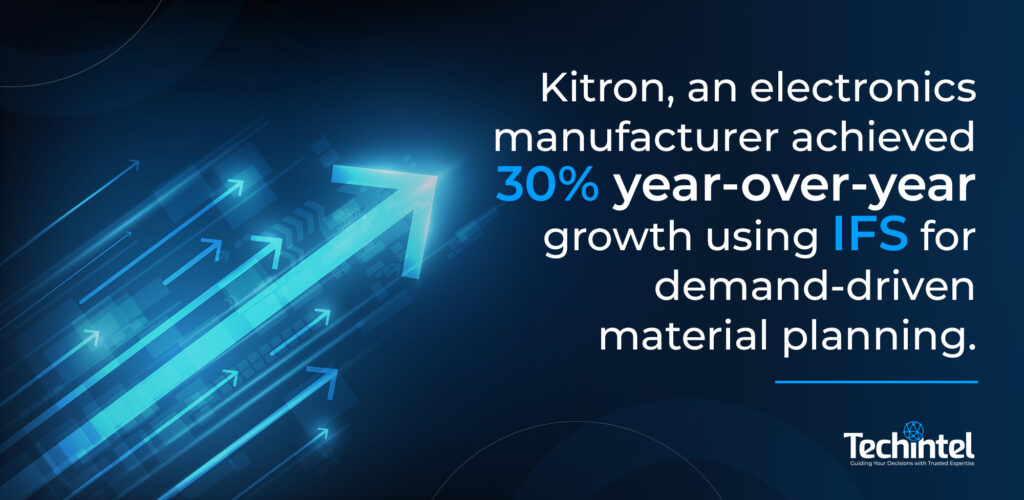
  • Kitron: This electronics manufacturer achieved 30% year-over-year growth and reduced inventory by 40% using IFS for demand-driven material planning. The system streamlined supplier management and standardized processes across six countries.
  • KBR Poland: By integrating IFS ERP, the company shortened monthly financial closures, simplified tax processes, and automated invoicing directly from work orders, enhancing operational transparency.
30% growth by using IFS for demand-driven material planning

Best Practices for Implementing IFS ERP

To maximize Return On Investment, manufacturers should:

  1. Align ERP Goals with Business Objectives: Identify pain points like inventory waste or production delays, and tailor IFS modules to address them.
  2. Phase Implementation: Roll out modules incrementally—start with core areas like production planning before expanding to supply chain or EAM.
  3. Train Employees: Ensure teams understand how to leverage IFS tools, such as real-time dashboards or automated workflows.
  4. Collaborate with IFS Partners: Kitron’s success stemmed partly from treating IFS as a strategic partner, co-developing solutions to meet evolving needs.
  5. Monitor and Optimize: Use IFS analytics to track KPIs like equipment uptime or order fulfillment rates, refining processes continuously.

Summary

IFS ERP isn’t just software—it’s a catalyst for manufacturing excellence. By unifying operations, enhancing visibility, and automating workflows, it empowers companies to slash costs, accelerate production, and deliver superior products. As proven by industry leaders like Kitron and KBR Poland, the right implementation strategy turns ERP systems into a competitive edge, ensuring manufacturers thrive in an era where efficiency defines success.

Let’s Solve Your ERP Challenges Together!

We’d love to hear from you! Tell us what ERP or business challenges you’re currently facing — and we’ll get back to you with tailored insights, solutions, or resources.

TAGS:
743 views

Top 7 Features of IFS ERP of Industrial Manufacturing Companies

The mechanical engineering industry faces significant challenges in 2025, including talent shortages affecting 78% of firms, supply chain disruptions causing 23% production delays, and regulatory compliance costs consuming 12% of project budgets. IFS ERP emerges as a transformative solution with seven key features tailored to address these obstacles while enhancing operational efficiency. 

Comprehensive Project Management Tools 

IFS ERP provides real-time project tracking with automated KPI dashboards and predictive analytics. Its Project Management Module reduced schedule overruns by 41% at a German turbine manufacturer by optimizing resource allocation across 17 concurrent projects. The system automatically flags deviations from baseline timelines, enabling corrective actions within 48 hours of detection. 

Advanced Resource Planning Capabilities 

The platform’s AI-powered capacity modeling helps address the industry’s 1.2 million skilled worker shortage. A Texas-based equipment manufacturer achieved 34% higher workforce utilization using IFS’s skills-matching algorithms and 3D digital twin simulations. 

Customizable Workflow Engine 

IFS supports 150+ configurable workflow templates that helped a Swedish automotive supplier reduce engineering change order processing time from 14 days to 72 hours. The drag-and-drop interface allows non-technical staff to modify approval chains while maintaining audit trails. 

Features of IFS ERP of Industrial Manufacturing Companies

Integrated Supply Chain Management 

The SCM Module reduced inventory costs by 28% for a Japanese robotics firm through: 

  • Real-time supplier performance tracking (95% on-time delivery rate) 
  • Automated alternate vendor sourcing during port strikes 
  • Predictive material requirement forecasting with 92% accuracy 

Quality Assurance & Compliance 

IFS’s automated documentation system helped a European aerospace supplier achieve AS9100D certification 37% faster than industry average. The platform’s blockchain-enabled audit trails reduced compliance reporting time by 62%. 

Financial Management  

Real-time cost tracking across projects improved profit margins by 5.8% for a construction equipment manufacturer. The system’s currency hedging tools saved $2.1M annually on international procurement. 

User Adoption & Interface Design 

With 83% faster onboarding than legacy systems, IFS’s contextual UI adapts to user roles. A Malaysian plant reported 94% employee adoption within 3 weeks using: 

  • Voice-enabled work instructions 
  • Augmented reality maintenance guides 

Summary 

As mechanical engineering firms navigate 2025’s complex landscape, IFS ERP delivers measurable improvements in productivity (29% average increase), compliance efficiency (57% faster audits), and operational resilience (43% fewer supply disruptions). The platform’s continuous AI enhancements position it as essential infrastructure for next-generation engineering enterprises. 

Let’s Solve Your ERP Challenges Together!

We’d love to hear from you! Tell us what ERP or business challenges you’re currently facing — and we’ll get back to you with tailored insights, solutions, or resources.

TAGS: