



777 views

The Future of Industrial Automation: Leveraging IFS ERP Solutions 

As industries evolve through digital transformation, 2025 is set to be a crucial year for industrial automation advancements. Integrating robotics, Artificial Intelligence (AI), and the Internet of Things (IoT) will streamline production, improve accuracy, and minimize waste. Let’s explore how Enterprise Resource Planning (ERP) solutions like IFS are shaping the future of automation, enabling businesses to achieve unprecedented efficiency, precision, and scalability. 

Industrial Automation Trends in 2025 

Several key trends are defining industrial automation in 2025: 

  • AI-Powered Vision Systems: AI is the cornerstone of modern machine vision, with deep learning models detecting minor defects and adapting to dynamic production environments in real-time. 
  • Edge Computing:Edge computing ensures immediate insights, empowering decision-makers and reducing downtime. 
  • Collaborative Robots (Cobots):Cobots enhance human-machine collaboration, assisting in defect identification, reducing strain on workers by automating repetitive tasks, and improving precision in various processes. 
  • IIoT: The Industrial Internet of Things (IIoT) connects devices, sensors, and machinery, providing real-time data for enhanced monitoring and control. By 2025, more industries will leverage IIoT for end-to-end automation and resource optimization. The IIoT market is predicted to exceed $1 trillion by 2025, highlighting its transformative potential. 
  • Plug & Produce Solutions: These standardized automation solutions offer a quick way to optimize processes without lengthy integration. 
Benefits of IFS ERP in Automation

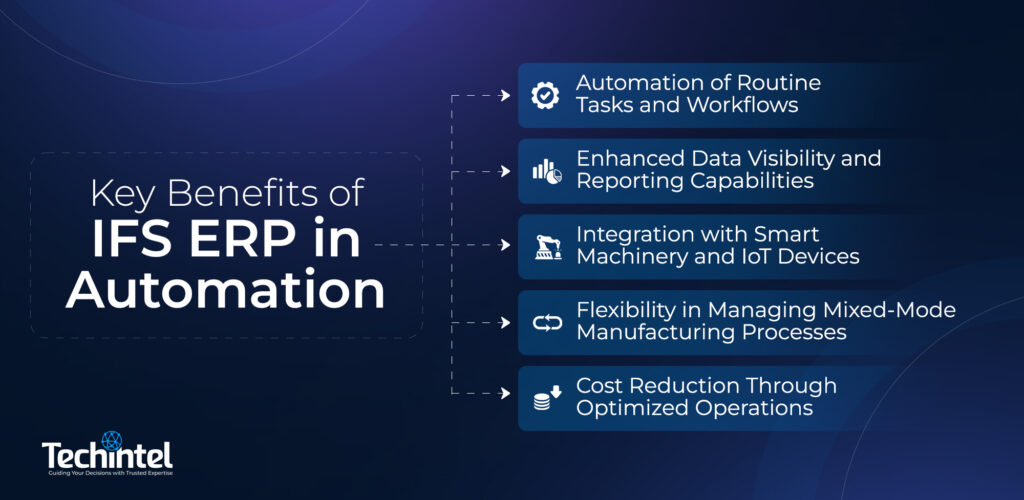
Key Benefits of IFS ERP in Automation 

IFS enables manufacturing companies to optimize their processes by automating certain activities, therefore increasing productivity. IFS provides a comprehensive view of all business processes, helping managers understand relationships between different processes and identify potential improvements, with benefits including: 

  • Automation of Routine Tasks and Workflows: IFS includes Business Process Automation features with a workflow engine embedded to enhance automation and tailoring. A workflow is a sequence of tasks that process a single data collection from a business and industry interaction. 
  • Enhanced Data Visibility and Reporting Capabilities: IFS helps improve operational efficiency by providing a comprehensive view of all business processes. This enables better understanding of the relationships between different processes and identification of potential areas for improvement. 
  • Integration with Smart Machinery and IoT Devices: Widespread adoption of IIoT continues to connect devices, sensors, and machinery, creating a cohesive ecosystem that provides real-time data for enhanced monitoring and control. 
  • Flexibility in Managing Mixed-Mode Manufacturing Processes: Automated systems that can quickly switch between production lines and product variants will become crucial. Modular production systems and cobots play a major role in this. Companies that can produce flexibly remain competitive in a rapidly changing market. 
  • Cost Reduction Through Optimized Operations: IFS allows manufacturing companies to reduce their costs by streamlining processes and eliminating redundant tasks. This results in significant savings in time, money, and other resources. 

A Real-World Example 

IFS partnered with Rolls-Royce to apply AI expertise and improve predictive maintenance on engines. They built an automated data pipeline from customers into Rolls-Royce, providing real-time in-service status of assets. This enables end-to-end sharing of data between the airline customer, IFS, and Rolls-Royce, supporting maintenance throughout the product lifecycle. 

Summary 

Industrial automation in 2025 is about integrating advanced technologies to achieve greater efficiency, adaptability, and precision. ERP solutions like IFS are at the forefront, offering the tools and capabilities needed to navigate this evolving landscape. By embracing these technologies and strategies, manufacturers can optimize their operations, reduce costs, and stay competitive in an increasingly dynamic market. 

Let’s Solve Your ERP Challenges Together!

We’d love to hear from you! Tell us what ERP or business challenges you’re currently facing — and we’ll get back to you with tailored insights, solutions, or resources.

TAGS:
824 views

The Strategic Advantage of Consultancy Before ERP Implementation 

Embarking on an Enterprise Resource Planning (ERP) implementation can be a game-changer for businesses, streamlining operations and boosting efficiency. However, without a solid strategy and expert guidance, the journey can be fraught with challenges. This is where the strategic advantage of consultancy comes into play, ensuring a smoother, more effective ERP deployment. 

Importance of Strategic Planning Before Implementation 

A clearly defined ERP strategy is not just a prerequisite but a critical success factor in any ERP project. It ensures that the ERP system aligns with the specific needs and goals of the business, maximizes the return on investment, and mitigates the risks associated with ERP implementation.  

Think of an ERP strategy as the backbone of a successful implementation, transforming business processes and systems in a way that supports overall business objectives. An ERP strategy defines the rules, components, and roadmap that will govern an industry-standard ERP deployment and its eventual utilization. 

To ensure that the overarching ERP strategy includes a path to achieve the company’s goals and objectives, it is essential to have the right mix of personnel included in both the planning and the execution. A comprehensive ERP Strategy Playbook should include these strategic elements united into a clear roadmap communicated to key stakeholders and maintained by the organization as things change. 

The Role of Consultancy in Ensuring Successful ERP Deployment 

Engaging a consultant can be the compass that guides your ERP implementation journey. An ERP consultant makes the process go a lot smoother, accelerates time to value, helps with mitigating project risks, and provides the organization with much-needed ongoing management and support. They bring a wealth of experience, helping to align the ERP system with your organization’s unique requirements and strategic goals. 

Common Pitfalls Businesses Face During ERP Implementation 

Without proper guidance, businesses often stumble into common pitfalls during ERP implementations. These can include: 

  • Failing to align the ERP system with business needs An ERP strategy is crucial for aligning solutions with specific business needs and goals. 
  • Underestimating the complexities of data migration Effective risk management involves identifying potential risks, such as data migration complexities. 
  • Poor user adoption Identifying potential roadblocks, such as resistance to change or lack of user adoption, and developing mitigation strategies to address them proactively is essential. 
  • Lack of a detailed project timeline Proper project planning involves creating a detailed project timeline. 

The average company ends up spending 2x–4x their budget and timeline when attempting an ERP project on their own. 

The Role of an ERP Consultant

The Role of an ERP Consultant 

An ERP consultant brings a multifaceted value to the table: 

  • Saving Time An experienced ERP project manager knows the best path forward and which factors can accelerate the process when done correctly. 
  • Saving Resources Experienced consultants understand prioritization of human resources, including when it is best to involve relevant company management and when it isn’t necessary. 
  • Saving Costs An experienced ERP consultant’s primary goal is to know every option, add-on, and customization available for your particular vertical and will know how to best build scalable flexibility without additional costs and penalties. 

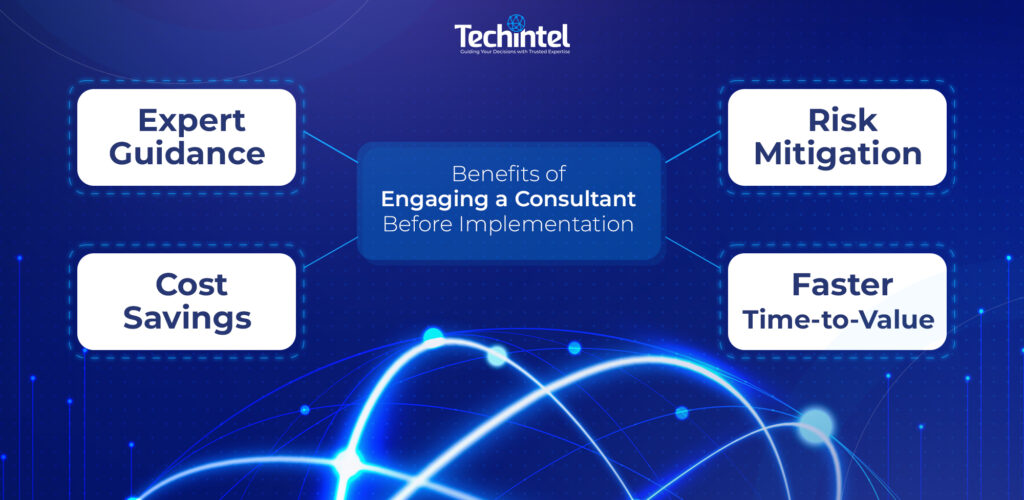
Benefits of Engaging a Consultant Before Implementation 

Engaging an ERP consultant before implementation offers numerous benefits: 

  • Expert Guidance: Benefit from the knowledge and experience of seasoned professionals. 
  • Risk Mitigation: Identify and address potential risks before they become costly problems. 
  • Cost Savings: Avoid unnecessary expenses through informed decision-making and efficient implementation. 
  • Faster Time-to-Value: Achieve a quicker return on investment with a streamlined implementation process. 

Summary 

In conclusion, the strategic advantage of engaging a consultant before ERP implementation cannot be overstated. From aligning the system with business goals to mitigating risks and ensuring cost savings, a consultant’s expertise is invaluable. By investing in consultancy, businesses can pave the way for a successful ERP deployment, driving efficiency and achieving long-term success in today’s dynamic business environment. 

Let’s Solve Your ERP Challenges Together!

We’d love to hear from you! Tell us what ERP or business challenges you’re currently facing — and we’ll get back to you with tailored insights, solutions, or resources.

TAGS: