



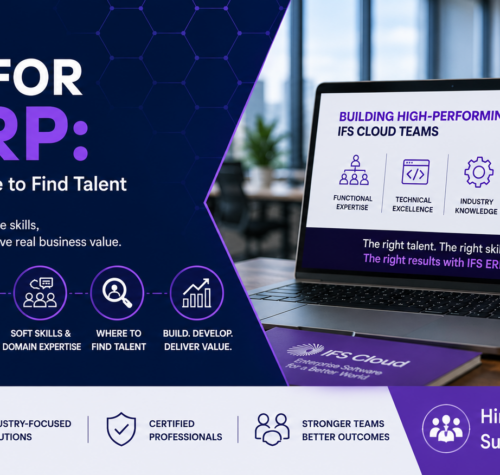
Hiring for IFS ERP: Skills, Roles & Where to Find Talent
Hiring for IFS ERP has become a strategic priority as more organizations move to IFS Cloud and adopt industry-specific modules. The demand for genuine IFS expertise has surged, and companies that can hire the right mix of functional, technical, and domain talent are the ones turning ERP programs into lasting business advantage.
Why expertise matters in Hiring for IFS ERP
Cloud migrations, tighter integration with IoT and field service, and a push for real-time operational visibility mean IFS is no longer just a back-office system. It is becoming the operational backbone for sectors like energy, manufacturing, utilities, and enterprise services.
That shift raises the bar for talent. Teams need people who understand not only IFS Applications or IFS Cloud, but also how modules like FSM, Manufacturing, Finance, and EAM fit together in complex, asset-heavy environments.
Key IFS roles to hire
Most successful IFS programs rely on a balanced core team supported by specialist freelancers or partners. Typical roles include:
- IFS Functional Lead / Senior Functional Consultant – owns module design, configuration, and business process alignment.
- IFS Technical Consultant / Developer – handles customizations, integrations, APIs, and technical administration in IFS Cloud.
- IFS Solution Architect – defines the overall IFS landscape, integration strategy, and long-term roadmap.
- IFS Project Manager / Product Owner – manages delivery, stakeholder expectations, and prioritization of IFS capabilities.
- Module Specialists (Finance, Manufacturing, FSM, EAM, Projects) – deep experts in specific functional areas who drive configuration, testing, and training.
Hard skills checklist per role
Functional consultants and module specialists
- Strong knowledge of core IFS modules: Finance, Supply Chain, Manufacturing, Project, Service Management (FSM), EAM.
- Experience with full lifecycle IFS implementations and upgrades, preferably in IFS Cloud.
- Comfortable with business process mapping, gap analysis, and configuration of IFS parameters, master data, and security roles.
- Ability to design and execute functional test plans and UAT scripts.
- Basic SQL skills for data analysis and troubleshooting.
Technical consultants and developers
- Hands-on experience with IFS Cloud technical administration, including Lobies, custom fields, events, and workflows.
- Proficiency in REST/OData APIs, IFS Connect, and integration patterns with middleware and third-party systems.
- Strong SQL and PL/SQL (Oracle) for reporting, data migration, and performance tuning.
- Understanding of IoT connectors, MES integrations, and shop-floor data flows for manufacturing and EAM use cases.
- Familiarity with security/permission sets, data migration tools, and extension frameworks in IFS Cloud.
Architects and leads
- End-to-end view of IFS Cloud architecture, multi-module landscapes, and integration strategies.
- Ability to align IFS capabilities with industry processes in energy, manufacturing, utilities, and asset-intensive sectors.
- Experience guiding technical and functional teams, setting standards, and reviewing designs.
Certifications to look for
Certifications help filter for candidates with verified IFS knowledge. Useful credentials include:
- IFS Certified Practitioner – Technical Consultant (IFS Cloud) – proves skills in technical administration and IFS Lobby.
- IFS Certified Expert / Practitioner – Functional tracks such as Projects, Financials, Supply Chain, Manufacturing, HCM, or Asset Management.
- IFS Cloud course completions and badges from the official IFS learning catalog, especially for new cloud features and modules.
While not mandatory, these badges signal structured learning and a baseline understanding of IFS best practices.
Soft skills and domain experience
Technical depth is vital, but IFS projects fail or succeed based on people skills and business understanding.
- Process thinking – ability to translate messy real-world processes into clean IFS configurations and workflows.
- Stakeholder management – working with finance, operations, maintenance, and IT to align priorities and manage change.
- Vendor and partner collaboration – coordinating with IFS partners, integrators, and third-party vendors without losing ownership.
- Industry vertical experience – prior exposure to energy, manufacturing, utilities, aerospace and defense, or enterprise services is a strong differentiator.
Candidates who have lived the pain points of these industries tend to design more practical IFS solutions and gain faster user adoption.
Where to find IFS talent
The IFS talent pool is specialized and competitive, so a multi-channel approach works best.
- Specialized recruitment agencies that focus on ERP and IFS roles can tap into hidden networks of consultants and freelancers.
- Professional networks and communities – LinkedIn groups, IFS-focused forums, and conference attendees are rich sources of experienced practitioners.
- Talent pools and passive candidates – building relationships with past applicants and IFS community members speeds up hiring when roles open.
- Remote and hybrid roles – offering flexible work arrangements widens the geographic reach and makes positions more attractive.
Recent hiring trend reports note sustained demand for IFS skills across regions, with particular pressure on cloud, EAM, and manufacturing expertise.
Closing tips: compensation, career path, and upskilling
To attract and retain top IFS talent, treat these roles as strategic investments.
- Offer competitive compensation aligned with global IFS market rates, especially for cloud and niche module experts.
- Define clear career paths from consultant to lead, architect, and product owner, so people see long-term growth inside your organization.
- Invest in upskilling programs using IFS learning catalogs, certifications, and internal knowledge-sharing sessions to build bench strength.
- Organizations that combine smart hiring with continuous development will not only fill roles faster, but also build the internal capability needed to get lasting value from IFS ERP.
Let’s Solve Your ERP Challenges Together!
We’d love to hear from you! Tell us what ERP or business challenges you’re currently facing — and we’ll get back to you with tailored insights, solutions, or resources.